

March 31, 2026
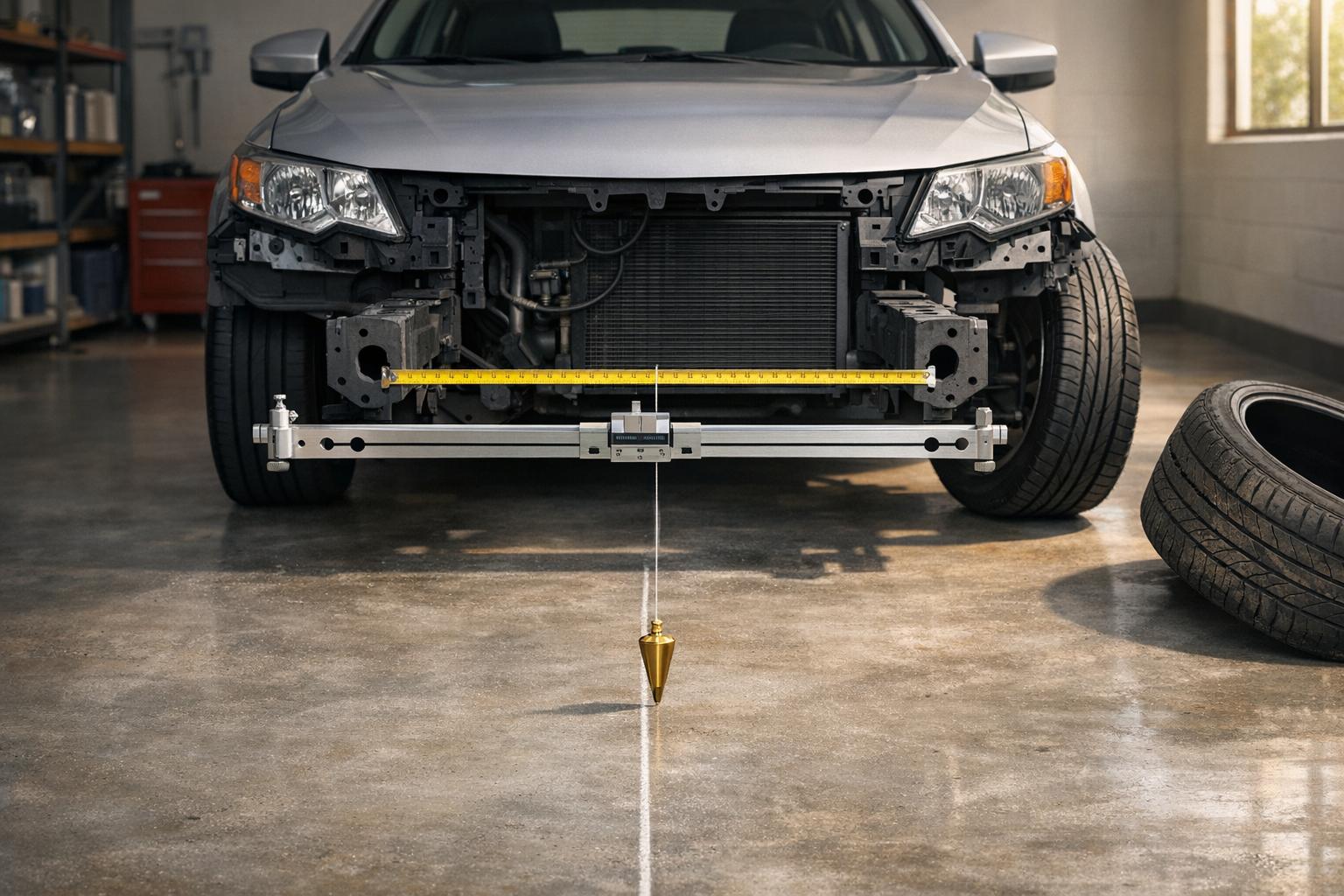
If your car has been in an accident, frame damage can pose serious safety risks and lead to costly repairs if ignored. Here’s how you can check for potential frame issues:
Frame damage isn’t always obvious but can severely impact your car’s safety and performance. If you suspect issues, act quickly to prevent further complications.

5-Step Guide to Checking for Frame Damage After a Car Collision
Safety should always come first when checking for frame damage. After a collision, a vehicle can have hidden dangers like leaking fluids or weakened structural parts. Taking the right precautions ensures the inspection process is both safe and effective.
Start by parking on a flat, level surface, turning off the engine, and engaging the parking brake. Choose a well-lit area where you can easily walk around the vehicle. Good lighting is crucial for spotting damage. If you need to inspect the undercarriage, make sure there's enough room to safely set up jack stands and maneuver underneath.
"To make sure you have good visibility during inspection, make sure you examine the vehicle under proper lighting." - Rogo Fastener Co., Inc.
Before diving into the inspection, double-check that the vehicle is stable and secure in its parked position.
If you suspect frame damage, avoid driving the vehicle. A bent frame compromises crash protection and can affect steering and suspension. Warning signs may include the car pulling to one side, unusual vibrations, or unstable handling.
"It's not safe to drive a car with a bent or broken frame." - Michael Whittemore, Author
Driving a vehicle with frame damage can also overstress vital components like the steering, suspension, and drivetrain, leading to premature failures. If the car isn't in a safe spot for inspection, it's better to have it towed to a secure location rather than risk further damage or a dangerous situation.
Protect yourself by wearing gloves and safety glasses to avoid injuries from sharp edges or broken glass. A high-powered flashlight is essential for examining dark areas like the undercarriage and wheel wells, where damage often hides. If you need to get underneath the vehicle, always use jack stands - never rely solely on a jack, as it can fail and cause serious injury.
Take photos and notes during your inspection. This documentation can be invaluable for repair professionals and helps you monitor any changes in the damage over time.
With these safety measures in place, you're ready to begin a thorough visual inspection of your vehicle's frame.
Once safety is ensured, take a walk around your parked vehicle to examine its exterior and undercarriage. Frame damage often reveals itself as warped or distorted metal.
Pay close attention to areas designed to absorb impact, like bumpers, fenders, and the undercarriage. Use a flashlight to check underneath the vehicle. Inspect the frame rails for signs of bending, rippling, creasing, or other deformations.
Watch for wavy distortions paired with paint cracks - these can indicate compression or twisting. Additionally, fresh fluid leaks beneath the car might point to frame damage, as shifts in the frame can misalign engine or transmission mounts, causing seals to break or fluid lines to strain.
After spotting any metal damage, check if the body panels show similar misalignments.
Step back and compare both sides of the vehicle. Consistent gaps between panels indicate proper alignment, while uneven spacing often signals a shifted frame.
"If the space is uneven between these parts or if there is apparent damage from one part hitting another, that's an indication that the frame underneath them has been damaged." - Michael Whittemore, Author
Test the doors, hood, and trunk to ensure they open and close without resistance. If a door "pops" when shutting or doesn’t sit flush, the mounting points may have shifted. Similarly, check if headlights, the grille, or bumpers appear off-center or crooked - this often means the mounting points have moved due to frame damage. Listen for any squeaks or creaks, which could indicate parts rubbing together improperly.
Finally, examine the undercarriage for rust or paint cracks that might conceal more serious problems.
Cracked paint near metal distortions is a strong indicator of frame damage. When a frame bends or buckles, the protective coatings stretch and break, exposing the bare metal beneath. Focus on paint cracks near rippled or creased areas on the frame rails.
Check the undercarriage for rust on the frame rails, as corrosion can weaken the structure or hide cracks caused by impacts. Even if the exterior appears fine, frame damage can occur even in minor accidents like fender benders. Professional computerized measuring systems can detect deviations as small as 1mm, so what looks straight to the eye might still be compromised.
| Sign of Damage | Visual Indicator | Potential Frame Issue |
|---|---|---|
| Uneven Gaps | Wide space at the top of a door, narrow at bottom | Sway or sagging frame |
| Door Malfunction | Door "pops" or resists closing | Shifted mounting points/Twisted frame |
| Metal Rippling | "Waves" in the floor pan or frame rails | Mashed or compressed frame |
| Panel Rubbing | Paint wear where the hood meets the fender | Diamond or sway damage |
Once you've visually inspected the frame, basic measuring tools can help uncover hidden alignment issues. The frame acts as the vehicle's backbone, and precise attachment of components is crucial for safe performance. Even small misalignments can affect how the vehicle operates.
A tape measure is a handy tool for checking frame twists. To start, measure diagonally across the vehicle - from the front left corner of the windshield to the rear right corner of the bumper. Then, repeat this process for the opposite diagonal (front right to rear left). In a properly aligned frame, these two measurements should be nearly the same. If they differ, the frame might be twisted.
You can also measure door jamb gaps at three points: the front, middle, and rear. Uniform gaps indicate proper alignment, while variations suggest the frame may be bent or compressed. Always take measurements between fixed reference points, such as suspension mounting holes or body panel edges, to ensure accuracy. Avoid flexible or movable areas.
For greater accuracy, consider using a tram gauge alongside your tape measure.
A tram gauge, which consists of an adjustable bar with pointed ends, offers a more precise method for comparing distances. To use it, lock the gauge to a reference distance from an undamaged section of the frame. Then, compare this distance to corresponding points in the area you suspect is damaged.
While professional shops rely on computerized systems capable of detecting even 1 mm frame deviations, a tram gauge can help identify larger discrepancies that indicate significant damage. If the distances between corresponding points don't match, it’s a sign the frame has shifted. Keep in mind that many modern vehicles use unibody construction, where the frame and body are integrated into a single structure. Proper alignment is critical for maintaining safe handling and performance.
Your vehicle's behavior on the road can often reveal frame issues that aren't immediately visible. Changes in handling and tire behavior can signal underlying damage to the frame.
If your car starts pulling to one side unexpectedly, it might point to frame damage. This happens because the wheels are mounted directly to the frame, and any bending in the frame disrupts their alignment.
Pay attention to new noises, like squeaks or creaks, especially after a collision. These sounds often mean parts of the vehicle are rubbing together in ways they shouldn't - an issue caused by the frame shifting out of its proper position. You might also notice unusual vibrations, particularly at higher speeds or during turns. This instability stems from the bent structure affecting how the vehicle handles.
To safely check for these problems, find a flat, empty lot for a test drive. Turn off your radio and air conditioning to better hear any odd sounds. Observe whether the steering wheel sits off-center when driving straight and notice if the car pulls or drifts, requiring constant steering adjustments.
In addition to handling issues, tire wear patterns can provide more evidence of alignment problems.
Uneven tire wear - like bald spots or feathered edges - can indicate misaligned wheels caused by frame damage. Look closely at the treads on all four tires. If there's a noticeable difference in wear between the inner and outer edges, it could point to structural issues.
Another way to check is by observing your tire tracks in wet conditions. If the tracks appear irregular or the vehicle seems to "crab" (move slightly sideways while driving forward), it’s a sign the frame might be bent or twisted. These misalignments not only affect how your car handles but can also lead to faster tire deterioration, costing you more in the long run.
While you might spot obvious damage during a DIY inspection, subtle frame issues often go unnoticed. Even minor collisions can lead to hidden problems that pose serious safety risks.
Basic tools like a tape measure can only provide rough estimates, leaving complex issues undetected. Professional repair shops, on the other hand, use advanced electronic measuring systems to uncover problems such as misaligned engine mounts, damaged seals, or strained fluid lines - issues that are nearly impossible to diagnose at home.
"Many components of your car rely on being attached to a precise spot on a car's frame to properly function, meaning that it's not safe to drive a car with a bent or broken frame." – Michael Whittemore, Author
Modern vehicles with unibody construction require precise alignment. Even small frame shifts can throw off weight distribution, putting extra strain on shock absorbers and other parts. Skilled technicians and specialized tools are critical for restoring your car’s frame to its original condition, ensuring it’s safe to drive again.
If you’re looking for accurate repairs and peace of mind, consulting a trusted professional is a must.
For drivers in Boise, Franklin Auto Body provides expert frame damage assessments. Their I-CAR GOLD CLASS certified technicians use state-of-the-art equipment to restore vehicles to factory standards. They service all makes and models, offering everything from diagnostics to full collision repair. Plus, they assist with insurance claims and rental car arrangements. Visit Franklin Auto Body to schedule a detailed frame inspection and get your car back on the road safely.
Frame damage isn't something to take lightly - it directly affects your safety. Your vehicle's frame acts as its structural backbone, and any compromise in its integrity reduces crash protection and puts extra strain on critical systems like steering and suspension. This strain can lead to premature failures, escalating into more serious problems if left unaddressed .
Neglecting frame issues can cause uneven tire wear, fluid leaks, and rust, all of which weaken the frame over time. What might seem like a minor issue today can quickly snowball into expensive and extensive repairs down the road.
"Even a minor fender bender can cause lasting frame damage that turns your vehicle into a hazard on the road." – Michael Whittemore, Author
This is why professional diagnostics are so critical. While a DIY inspection might catch visible damage, it takes professional tools and expertise to uncover hidden issues. Modern vehicles, especially those with unibody construction, require specialized equipment to ensure proper alignment and weight distribution .
If you're in need of a detailed frame assessment, consider visiting Franklin Auto Body in Boise, Idaho. Their I-CAR GOLD CLASS certified technicians use state-of-the-art diagnostic tools to bring your vehicle back to factory standards. Don't risk your safety - trust professionals who understand the importance of a secure and properly aligned frame.
Significant frame misalignment can compromise both the safety and performance of your vehicle. While there isn’t a precise threshold for what qualifies as "too much", there are some clear warning signs to watch for. These include visible bending or twisting of the frame, uneven tire wear, steering problems, or unusual gaps between body panels. If you notice any of these, it’s essential to have your vehicle inspected. A professional repair shop, such as Franklin Auto Body, can assess the damage and determine the necessary steps to restore the vehicle's structural integrity.
Absolutely. A car's structural integrity plays a crucial role in how airbags and other safety systems perform, especially after a collision. If the frame is damaged, it could interfere with the proper deployment of airbags or disrupt other safety features meant to protect you during an accident. These systems rely on a stable structure to work as intended, so any compromise in the frame could pose serious risks.
Whether your insurance covers frame inspection and repairs largely depends on the specifics of your policy and the nature of the accident. If the collision falls under your coverage, insurance companies often handle the costs for inspections and repairs, particularly if the vehicle’s safety or structural integrity is at risk. Typically, a professional inspection is required since insurers may need a detailed report before approving any repairs. To get a clear answer, review your policy or contact your insurance provider directly.
